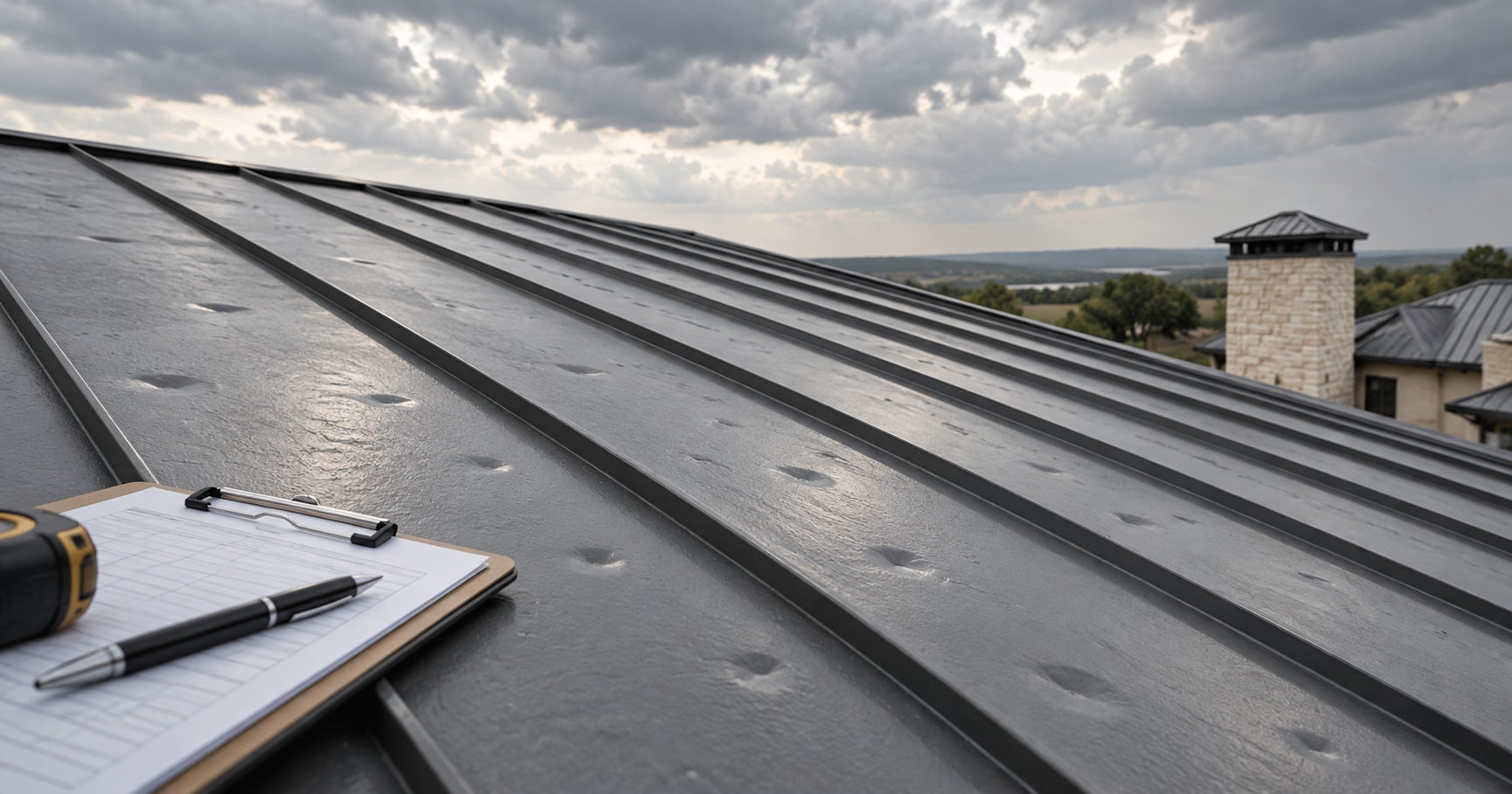
The storm left dents across the roof. Your contractor recommends replacement. The insurer calls the damage cosmetic and declines to pay for the roof.
The disagreement can involve a great deal of money, but the price of replacement does not decide coverage. Neither does the adjuster's label. Start with the actual endorsement, then determine what the physical evidence proves under that language.
This article addresses Texas insurance disputes. The two federal decisions discussed below involved residential metal roofs. Their policy wording and evidentiary lessons are useful, but a commercial policy needs its own analysis.
Find the Endorsement That Was Actually Issued
Obtain the complete policy for the loss date, including the declarations, forms schedule, endorsements, and any amendments. Identify the provision the insurer relies on and whether that provision is actually part of the issued policy.
Then separate the questions. Is there covered physical damage? Does a cosmetic-damage exclusion apply? Does the endorsement preserve coverage under a particular exception? What roof components does it address?
Some wording focuses on damage limited to appearance. Other wording expressly addresses hail damage and a leaking exception. Those provisions can require different proof. An engineer's use of the word functional is not a substitute for comparing the observed condition with the contract.
Two Decisions Show Why Wording Matters
In Wheeler v. Safeco Insurance Co. of Indiana, No. 5:21-cv-00343-XR, slip op. at 7–9, 15–16 (W.D. Tex. Apr. 29, 2022), the policy defined cosmetic damage as “any loss that is limited to the physical appearance of a metal roof surface.” Conflicting expert evidence left a factual dispute over whether the damage fell within that description. The court denied the insured's request for summary judgment on the contract claim; the contract and prompt-payment claims remained pending. It dismissed the Chapter 541 and § 542.003 claims. This was a mixed procedural ruling, not a final coverage victory for the homeowner.
A different endorsement produced a different problem in Nguyen v. Allstate Vehicle & Property Insurance Co., No. 2:24-cv-00186-Z-BR, slip op. at 2, 13–16 (N.D. Tex. Feb. 23, 2026). The policy's exception required hail damage that “results in water leaking through the surface of a metal roof.” The insurer attributed the garage leak to deficient flashing rather than the claimed storm. The insured lacked competent evidence connecting the roof damage, storm, and leaking exception. The court granted summary judgment to Allstate and dismissed the case with prejudice.
These trial-court decisions illustrate particular policy language and records. They do not establish one rule for every roof or every cosmetic exclusion.
Connect the Roof Condition to the Policy
An inspection should identify the affected component and explain what changed. Depending on the roof and endorsement, relevant questions may concern opened seams, fractured metal, damaged coatings, fastening strength, water shedding, or the source of a leak.
Ask the expert to explain the mechanism. If a dent damaged a protective coating, what supports that conclusion? If the opinion concerns reduced service life, how was that reduction evaluated? If water entered the building, where did it enter and why is that condition attributed to the claimed storm?
A replacement estimate answers a pricing question. It may not answer causation, the applicability of an exclusion, or whether a particular repair restores the covered damage. The report should connect those steps rather than leave the court to supply them.
Address the Evidence That Hurts the Claim
Review earlier storms, prior repairs, maintenance issues, installation details, photographs, and the roof's condition before the claimed event. Preserve the first inspection images and compare them with later photographs.
A contractor may sincerely believe replacement is appropriate while lacking the information needed to date the damage. An interior stain may have several possible explanations. An opinion should confront those alternatives, identify the evidence supporting its conclusion, and state its limits.
The same discipline applies to the insurer's report. Examine whether the inspector accessed the relevant roof areas, investigated the reported conditions, and connected the observations to the exclusion being invoked. A report should be evaluated on its methods and support, rather than accepted or rejected because of who retained the author.
Preserve the Roof While Protecting the Building
Take practical steps to protect the building and document why emergency work is necessary. Photograph conditions before repairs, record locations, and preserve removed samples when reasonably feasible. Coordinate inspection opportunities and check policy duties before substantial alteration.
Keep emergency mitigation costs separate from the proposed permanent repair scope. Retain invoices and proof of payment. If an ordinance or code issue affects the estimate, identify the actual requirement and the policy provision said to cover the additional cost.
Document why repair or replacement is proposed for each component. Mixing storm work with unrelated upgrades makes the disputed amount harder to assess.
Build the Claim Before the Demand
Prepare a focused comparison of the policy language, insurer's stated reason, observed condition, and supporting evidence. Identify what remains disputed and what further inspection or testing could resolve it.
Before suit, evaluate the applicable notice requirements. For actions covered by Chapter 542A, Texas Insurance Code § 542A.003(a)–(d) generally requires written notice no later than the 61st day before filing, subject to specified exceptions. The notice must address the alleged acts or omissions, the specific amount allegedly owed, and the prescribed attorney-fee information. Policy notice and suit deadlines require separate review.
A useful challenge to a cosmetic-damage denial begins with the endorsement and a defensible explanation of the damage. If the evidence supports only excluded appearance changes, the claim has a real obstacle. If the evidence establishes a condition the exclusion does not reach, the insurer should be required to address that condition specifically.
Contact Matthew Clarke to discuss a disputed property-insurance claim.
Related reading: Lender-Controlled Reserves and Insurance Proceeds and Defend Versus Indemnify, which addresses the separate promises in liability insurance.
Matthew M. Clarke is a shareholder at Kelley Clarke, PC and Chair of Litigation. He represents policyholders and businesses in insurance and commercial disputes. This article is for general information and is not legal advice. Reading it does not create an attorney-client relationship.