Texas Guarantors, the Fair Market Value Offset, and the Waiver That Usually Decides the Case
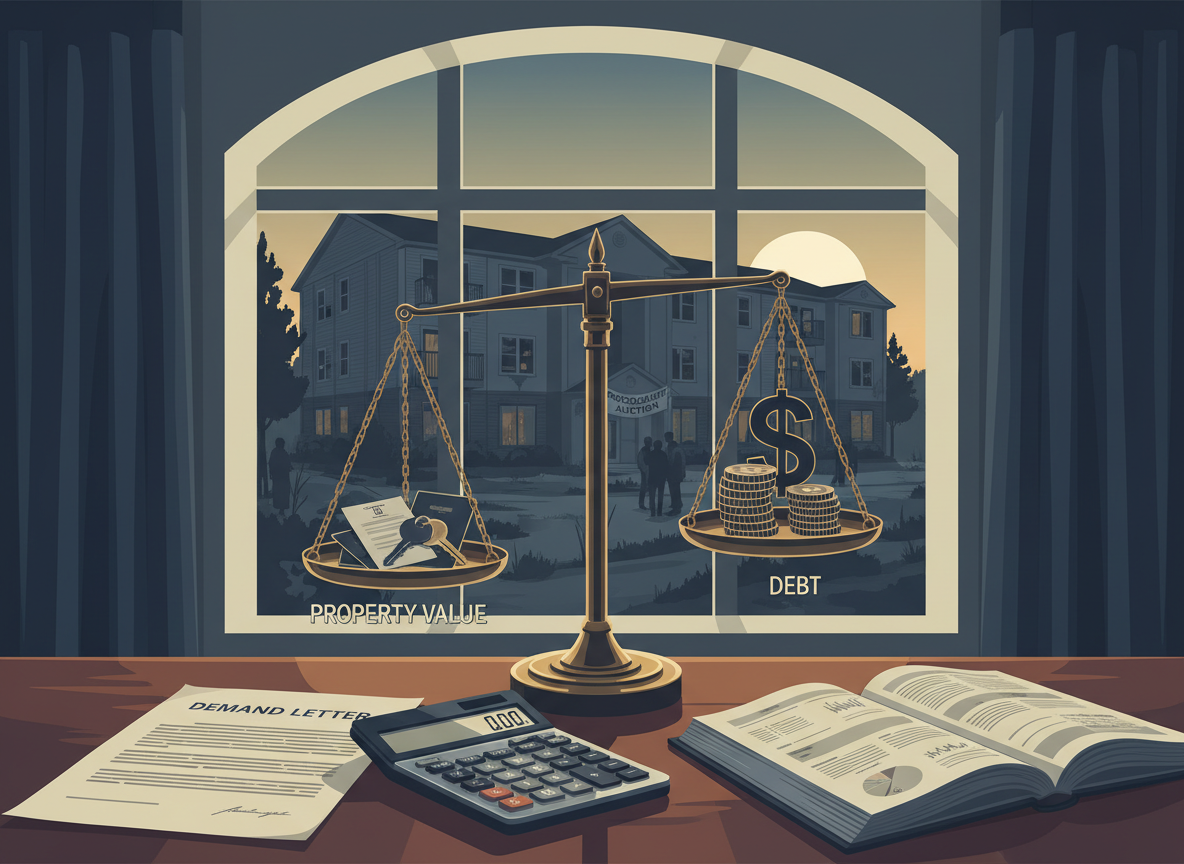
The foreclosure sale is over. The lender bought the property with a credit bid. A few weeks later, the guarantors receive a letter demanding millions of dollars, the difference between the loan balance and what the lender bid for a property it now owns.
Many guarantors assume the foreclosure ended their exposure. It did not. In many cases it simply fixed the number the lender will try to collect.
The Statute Texas Guarantors Hear About First
Texas has a statutory check on lowball foreclosure bids. When property sold at a nonjudicial foreclosure brings less than the unpaid debt, any action to recover the deficiency must be brought within two years of the sale. Tex. Prop. Code § 51.003(a).
A person against whom the deficiency is sought may ask the court to determine the property’s fair market value as of the foreclosure date. Tex. Prop. Code § 51.003(b). If the fact finder determines that fair market value exceeds the sale price, the defendants receive an offset equal to the difference, after subtracting liens that survived the foreclosure. Tex. Prop. Code § 51.003(c).
The statute also contains a quiet trap. If no party requests a fair market value determination, or no competent evidence of value is introduced, the foreclosure sale price is used to compute the deficiency. Tex. Prop. Code § 51.003(c). The offset is not automatic. A guarantor who wants it must ask for it and prove it, usually with an appraiser.
The Waiver Problem
Here is where most deficiency disputes are actually decided. Commercial guaranties are full of waiver language, and Texas courts enforce it.
In Moayedi, the guaranty waived “any,” “each,” and “every” defense other than full payment. The guarantor argued that a general waiver could not surrender a specific statutory right that it never mentioned. The Texas Supreme Court disagreed, explaining that “[t]o waive all possible defenses seems to very clearly indicate what defenses are included: all of them.” Moayedi v. Interstate 35/Chisam Road, L.P., 438 S.W.3d 1, 8 (Tex. 2014). The guarantor lost the offset.
Earlier this year, the Fort Worth Court of Appeals applied the same reasoning to a modern guaranty. The guarantor argued that the anti-deficiency waiver addressed only the borrower’s rights. The court rejected that reading, held that the guaranty clearly and specifically waived the guarantor’s ability to invoke section 51.003, and affirmed a judgment for the full deficiency the lender claimed. Liberty Centerpoint, LLC v. Pinnacle Bank, No. 02-25-00223-CV (Tex. App.—Fort Worth Jan. 15, 2026).
The practical lesson is uncomfortable. If you signed a typical institutional guaranty, assume the fair market value offset is probably waived until a careful reading proves otherwise.
If the Offset Is Gone, the Fight Is Not
A waiver of the statutory offset is not a waiver of arithmetic. The lender still has to prove the deficiency it claims, and deficiency calculations are where lenders make mistakes. Look closely at these questions.
- Were reserves, escrows, and insurance proceeds credited? Lenders often hold substantial funds at foreclosure. Where did that money go?
- Were receivership collections applied? If a receiver collected rents before the sale, the accounting matters.
- Is default interest properly calculated? Check the trigger date, the rate, and whether the default was ever validly declared.
- Are the fees reasonable and recoverable? Legal fees, property protection advances, and “costs of enforcement” are frequently overstated.
- Was the sale itself properly noticed and conducted? A defective foreclosure can change everything that follows.
- What exactly does the guaranty cover? A nonrecourse carve-out guaranty is not a full payment guaranty unless a springing recourse trigger actually occurred.
Each of those items can move the number by six or seven figures, and none of them depends on the statutory offset.
Watch the Forum
Many institutional guaranties select New York law and New York courts, even for Texas properties. A guarantor who expects a Texas courtroom and a Texas statute may instead face a fast-track New York motion for summary judgment in lieu of complaint. We covered that procedure in Sued on a Guaranty in New York? Read the governing law and forum clauses before you assume which rules apply.
When the Deficiency Letter Arrives
- Calendar the two-year window from the foreclosure date.
- Pull the guaranty and identify every waiver, consent, and governing law provision.
- Request a complete payoff history and application of all reserves and receivership funds.
- Obtain an independent valuation as of the sale date, even if the offset may be waived. Value evidence often matters for settlement.
- Assess whether a carve-out trigger actually occurred or whether the lender is overreaching.
- Evaluate whether a negotiated resolution is better than litigation, before the lender files.
The Takeaway
The fair market value offset is a valuable protection that sophisticated lenders routinely draft away. Guarantors who rely on it alone are often disappointed. Guarantors who audit the lender’s numbers, test the carve-out trigger, and understand the forum usually find more room than the demand letter suggests.
Previous in the Distressed Commercial Loan series: The Forbearance Agreement May Be More Dangerous Than the Default.
Learn more about our Texas lender liability and commercial loan disputes practice. To discuss a loan or guaranty dispute, contact Matthew Clarke. Please do not send confidential information until the firm completes a conflict check and accepts the engagement.
Matthew M. Clarke is a shareholder at Kelley Clarke, PC and Chair of Litigation. He represents borrowers, guarantors, sponsors, investors, and businesses in commercial real estate and lender-liability disputes. He is also preparing the forthcoming Texas Lender Liability: A Practitioner’s Guide. This article is for informational purposes only and does not constitute legal advice. Reading it does not create an attorney-client relationship.